July 07 : 2025
Masoud Mirzaei
Mirzaei's image is mesmerizing. It captures a convergence of many current and historical issues, from climate change to tradition, in a way that is both captivating and beautiful.
by Lily Fierman

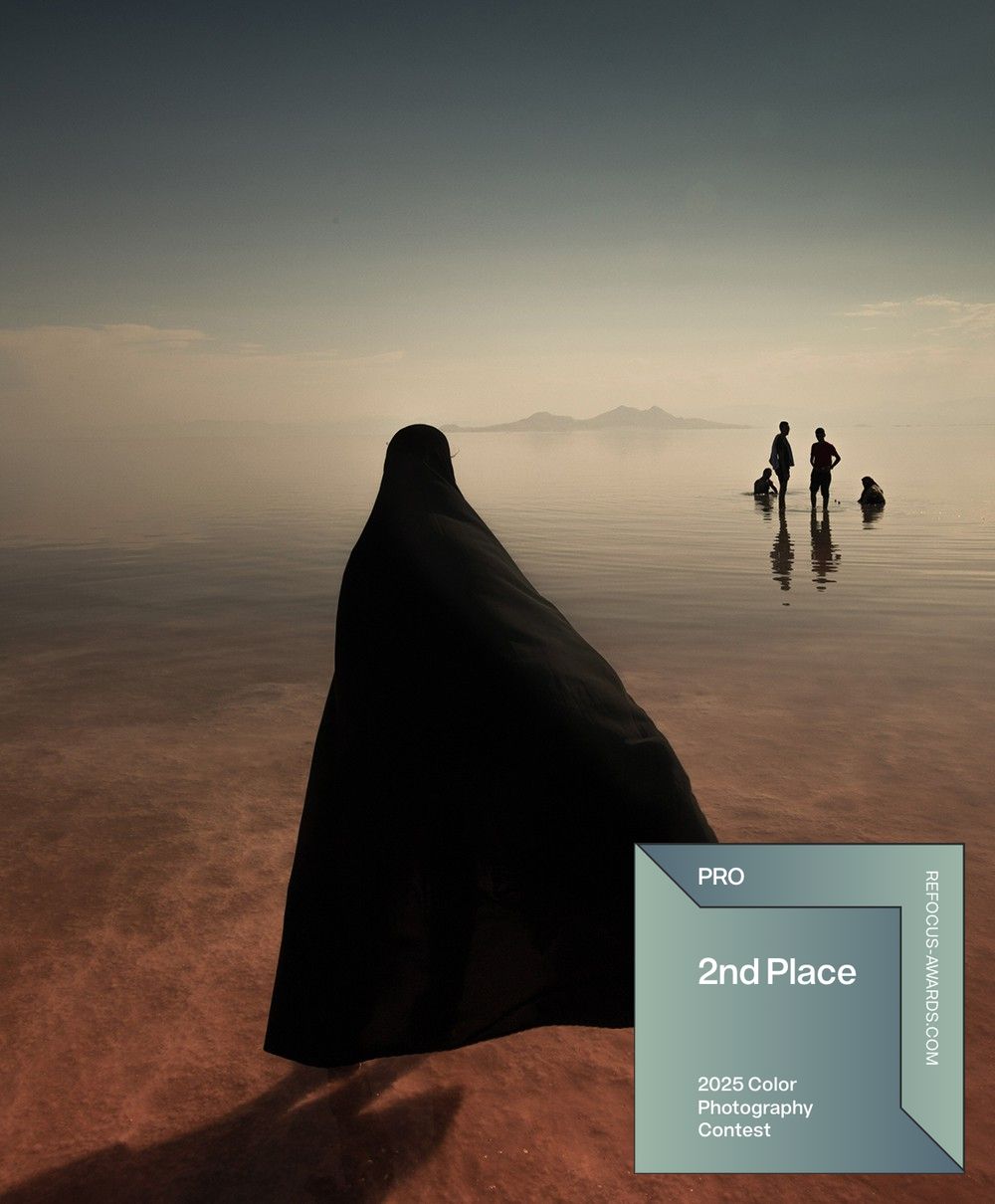
Image: The Lake
Q:
Can you please tell us more about creating your winning image, “The Lake”?
A:
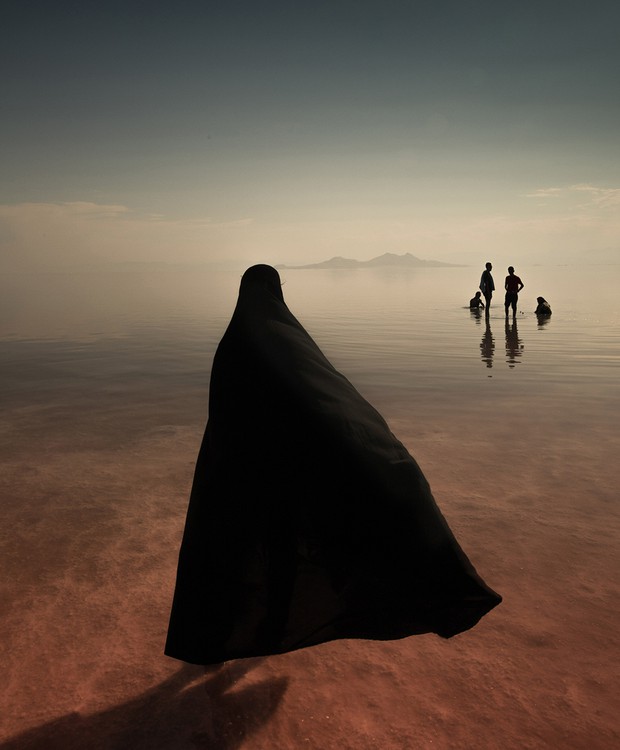
“The Lake” was made in a moment of stillness and contradiction where silence and movement, presence and distance, tradition and freedom coexisted in a fragile balance.
It was taken at Lake Urmia in northwestern Iran, a lake that was once among the largest saltwater lakes in the world. In recent decades, it has drastically shrunk due to climate change, drought, and mismanagement of water resources. What was once a vast, thriving body of water now feels like a fading memory.
I was walking quietly along the shore, listening more than looking.
There was no sound, except the distant splash of footsteps in the shallow water. The sky had turned into something weightless and faded, and the horizon seemed to dissolve into itself.
Then she appeared.
A figure in black, moving slowly and silently almost floating rather than walking. Her presence didn’t disturb the scene; it felt natural. Like wind, or shadow.
In front of her, a few people stood quietly in the water probably a family. They weren’t moving much, just watching the lake or maybe lost in their own thoughts.
I didn’t raise the camera right away. It felt like something in the mood or composition needed to settle first. I waited... and then pressed the shutter.
I don’t know if I took this photograph, or if it came through me.
Sometimes, images only appear when you’re quiet enough to receive them.
Later, I realized that tiny salt particles had gotten into my lens and camera body. There was a faint haze of salt in the air barely visible, but sharp enough to sting my eyes and leave a mark on my equipment.
It wasn’t an easy shoot. But in many ways, it became one of the most unforgettable projects of my life.
Q:
After browsing your other work, it’s clear you have a very defined palette; the colors are so uniquely yours. Can you tell us more about your use of color?
A:
My unique color palette has developed through a combination of experience, observation, and my personal feelings. I always try not to stray too far from the natural atmosphere during the color correction process, meaning I want the colors to remain realistic and believable. However, sometimes I adjust colors based on my own imagination and the emotions I want the image to convey.
I don’t follow any strict rules when editing colors. Ultimately, I believe that color should serve the mood of the photo it should feel both credible and add something meaningful to the image.
Color plays an important role in my visual identity, because I see it as a silent language that expresses emotions and tells stories. This is something I constantly try to maintain and develop in my work.
Q:
You do occasionally photograph in black and white. How do you choose color vs. black and white?
A:
I tend to shoot in color when I believe the colors can add depth and complexity to the concept and emotions I have in mind. Otherwise, I prefer black-and-white photography to express my ideas as simply and clearly as possible.
When I decide to shoot or present a photo in black and white, I usually consider whether this choice will help emphasize form, light, or convey a particular emotion. Black-and-white images have the ability to eliminate distractions and focus the viewer’s attention on shapes, contrasts, and the overall mood of the image.
Sometimes I decide before shooting whether the photo will be color or black-and-white, but more often the final decision is made during post-processing, depending on which version better communicates the intended message and feeling.
Color plays an important role in my visual identity, because I see it as a silent language that expresses emotions and tells stories
Q:
What are you working on next?
A:
Right now, I am trying to step outside the mental frameworks and familiar environments where I have worked before. I am seeking to experience something different—something like a journey into the unknown, even similar to migrating to an unfamiliar place.
At this stage, my focus is less on production and more on exploration and personal discovery. I want to deepen my understanding before creating, to allow new perspectives and ideas to emerge naturally.
The project is more about the process and the experience rather than a final product like an exhibition or a book. It includes elements of artistic and cultural exploration, but it is primarily an inward journey toward new perceptions.
Q:
Who are some of the photographers you admire?
A:
There are many photographers whose work has inspired me and whom I deeply respect. If I had to name just a few, I would mention Vivian Maier, Sebastião Salgado, Martin Parr, and more recently, Nadia Lee Cohen, whose work I really enjoy.
What attracts me in their photography varies from Vivian Maier’s intimate human stories and subtle compositions, to Salgado’s powerful social documentaries and mastery of light and shadow, to Martin Parr’s unique, often humorous perspective on everyday life, and Nadia Lee Cohen’s bold, stylized imagery.
ARTIST